

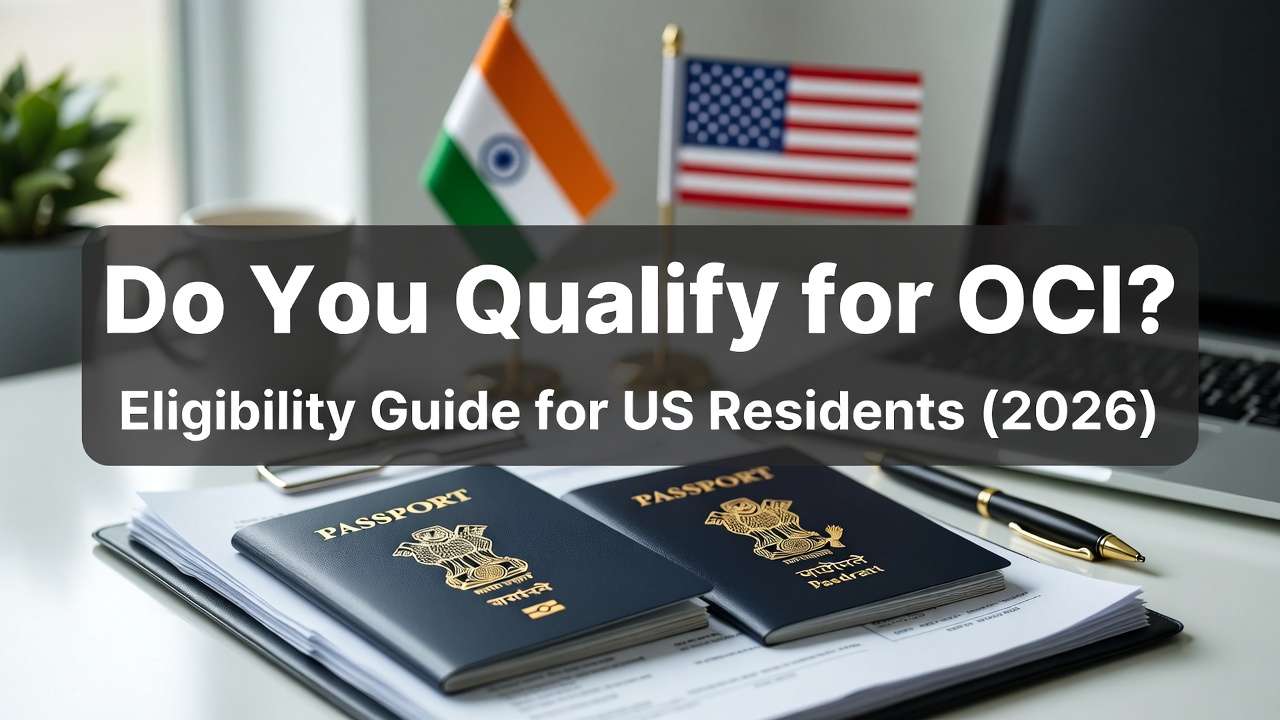
OCI Eligibility Criteria for US Residents (Complete 2026 Guide)
Contents
- 1 OCI Eligibility Criteria for US Residents (Complete 2026 Guide)
- 1.1 👉 Download the OCI Eligibility Checklist (Free PDF)
- 1.2 Who Is Eligible for OCI?
- 1.3 OCI Eligibility Through Parents
- 1.4 👉 Download the OCI Eligibility Checklist (Free PDF)
- 1.5 OCI Eligibility Through Grandparents
- 1.6 OCI Eligibility Through Great-Grandparents
- 1.7 👉 Download the OCI Eligibility Checklist (Free PDF)
- 1.8 OCI Eligibility for Minor Children
- 1.9 OCI Eligibility Through Spouse (Marriage Route)
- 1.10 Who Is Not Eligible for OCI
- 1.11 👉 Download the OCI Eligibility Checklist (Free PDF)
- 1.12 OCI Eligibility Checklist (Quick Self-Check)
- 1.13 👉 Download the OCI Eligibility Checklist (Free PDF)
- 1.14 Documents Required for OCI (USA Applicants)
- 1.15 How to Apply for OCI from the USA
- 1.16 OCI Benefits and Limitations
- 1.17 OCI Re-Issue and Passport Update Rules (2026)
- 1.18 👉 Download the OCI Eligibility Checklist (Free PDF)
- 1.19 FAQs
👉 Download the OCI Eligibility Checklist (Free PDF)
If you live in the United States and have Indian roots, you’ve almost certainly heard about OCI (Overseas Citizenship of India). What most people don’t know—at least not clearly—is whether they personally qualify.
That’s where the confusion starts.
Parents. Grandparents. Great-grandparents. Marriage rules. Pakistan or Bangladesh connections. Long document chains. Re-issue rules. Ask five people and you’ll hear five different answers—many of them outdated, incomplete, or just plain wrong.
This guide is written for US-based applicants, including US-born Indian Americans and naturalized US citizens, who want straight answers without legal jargon or guesswork.
By the time you’re done reading, you should have a solid sense of:
-
whether OCI is even an option for you
-
which eligibility route applies in your case
-
what documents you’ll realistically need when applying from the USA
-
where people usually get rejected (even when they are eligible)
-
and when it makes sense to slow down and get a second set of experienced eyes on your file
Along the way, you’ll see checklists, examples, and FAQs so you can pause, compare, and sanity-check your situation instead of guessing.
Who Is Eligible for OCI?
At its core, OCI eligibility comes down to two things: Indian origin or marriage to an Indian citizen or OCI holder. That’s the foundation. Everything else is detail.
And with OCI, the details matter.
All eligibility rules referenced below are based on the official OCI guidelines issued by the Government of India through the Ministry of Home Affairs
👉 https://ociservices.gov.in/
Let’s go through the main routes the way applicants usually encounter them.
OCI Eligibility Through Parents
You may qualify through your parents if at least one parent was an Indian citizen at the time you were born, as defined under the Indian Citizenship Act and OCI rules published by the Ministry of Home Affairs
👉 https://www.mha.gov.in/division_of_mha/foreigners-division
That one sentence clears up more confusion than most people realize.
Here’s what US applicants often misunderstand:
-
It matters when your parent was an Indian citizen, not what they became later
-
A parent becoming a US citizen later does not cancel your eligibility
-
Your parent doesn’t need to have been born in India—only eligible for Indian citizenship
A couple of real-world examples:
-
Born in the US in 1995. Father held an Indian passport until 2002 → Eligible
-
Born after both parents had already naturalized as US citizens → Not eligible under this route
Documents usually involved (as required during OCI submission via the official portal):
-
Your parent’s Indian passport (cancelled is acceptable)
-
Your birth certificate showing the parent’s name
-
Proof of your parent’s citizenship status at the time of your birth
👉 Download the OCI Eligibility Checklist (Free PDF)
OCI Eligibility Through Grandparents
This is one of the most common—and most misunderstood—ways people qualify.
You may be eligible through a grandparent if:
-
your grandparent was an Indian citizen on or after 26 January 1950, or
-
your grandparent was eligible to become an Indian citizen at that time
These criteria are explicitly outlined in the OCI eligibility section of the official Government of India portal
👉 https://ociservices.gov.in/faq
A few points that matter more than most people expect:
-
Citizenship after 26 January 1950 is the key cutoff
-
Being born in British-era India alone doesn’t automatically qualify
-
You must clearly link you → your parent → your grandparent with documents
One of the most frequent rejection issues we see:
Applicants submit proof for the grandparent but don’t clearly connect that proof to their parent.
Typical documents include:
-
Your grandparent’s Indian passport or citizenship proof
-
Your parent’s birth certificate
-
Your own birth certificate
OCI Eligibility Through Great-Grandparents
Yes, great-grandparents can qualify you—but this is where things get complicated quickly.
The rules allow it. The paperwork doesn’t forgive mistakes.
As confirmed under current OCI guidelines published by the Ministry of Home Affairs
👉 https://www.mha.gov.in/
What to know upfront:
-
Great-grandparents are within the permitted generational limit
-
Every generational link must be documented
-
One missing birth record or unexplained name change can derail the entire case
These applications often require:
-
Multiple affidavits
-
Clear explanations for name or spelling changes
-
Careful sequencing of documents
If this is your route, a pre-application eligibility review isn’t optional—it’s practical.
👉 Download the OCI Eligibility Checklist (Free PDF)
OCI Eligibility for Minor Children
Children under 18 may also qualify, depending on the parents’ status, as outlined by the Indian Embassy and Consulates in the United States
👉 https://www.indianembassyusa.gov.in/extra?id=74
In simple terms:
-
If both parents are OCI holders, the child is usually eligible
-
If one parent is OCI and the other is foreign, eligibility depends on documentation
-
Adopted children are reviewed more closely
In most cases, consent and documents from both parents are required.
OCI Eligibility Through Spouse (Marriage Route)
OCI through marriage exists—but it’s watched more closely than any other category under current Government of India policy
👉 https://ociservices.gov.in/
Who Can Apply as a Spouse?
You may qualify if:
-
the marriage is legally valid and officially registered
-
the marriage meets the required duration
-
your spouse is either an Indian citizen or an OCI cardholder
A common misunderstanding among US applicants:
-
Religious or online ceremonies alone are not sufficient
-
Court marriages must be properly registered to count
Conditions and Risks You Should Know About
Spouse-based OCI doesn’t work the same way ancestry-based OCI does.
A few realities to be aware of:
-
OCI can be cancelled if the marriage ends
-
Authorities may verify marital status in the future
-
Any false declaration can permanently affect eligibility
This is why spouse cases should never be rushed or filed casually.
Who Is Not Eligible for OCI
Just as important as eligibility is knowing when OCI simply isn’t possible.
Pakistan and Bangladesh Connections
As per the official OCI eligibility restrictions
👉 https://ociservices.gov.in/faq
You are generally not eligible for OCI if:
-
you currently hold, or previously held, citizenship of Pakistan or Bangladesh
-
your parent or grandparent held citizenship of either country
This restriction usually applies even if:
-
you are now a US citizen
-
the connection is through ancestry
👉 Download the OCI Eligibility Checklist (Free PDF)
OCI Eligibility Checklist (Quick Self-Check)
Ask yourself:
-
☐ Was I—or my parent, grandparent, or great-grandparent—eligible for Indian citizenship?
-
☐ Is there no Pakistan or Bangladesh citizenship connection?
-
☐ Can I clearly document the birth chain across generations?
-
☐ Do names, dates, and places match across documents?
-
☐ Do I know which eligibility route applies to me?
👉 Download the OCI Eligibility Checklist (Free PDF)
Documents Required for OCI (USA Applicants)
All documents are submitted online through the official OCI portal and physically via VFS Global, the authorized processing partner in the USA
👉 https://services.vfsglobal.com/usa/en/ind/apply-oci-services
Proof of Indian origin
-
Cancelled Indian passport (self or ancestor)
-
Birth certificates linking generations
-
Nativity or domicile certificates, if needed
US documents
-
US passport
-
Naturalization certificate
-
Legal name-change documents
Spouse cases
-
Registered marriage certificate
-
Spouse’s Indian passport or OCI card
-
Joint declaration
How to Apply for OCI from the USA
The process usually looks like this:
-
Complete the online OCI form
-
Upload supporting documents
-
Book a VFS appointment in the US
-
Submit biometrics and original documents
-
Track the application online
Most US applications take about 6–10 weeks, assuming documents are complete and consistent.
Common mistakes include:
-
unreadable scans
-
incorrect document order
-
missing declarations
OCI Benefits and Limitations
Benefits
-
Lifelong, multiple-entry access to India
-
No FRRO registration
-
Residential and commercial property ownership
Limitations
-
No voting rights
-
No government employment
-
No Indian passport
OCI Re-Issue and Passport Update Rules (2026)
-
One mandatory re-issue after turning 20
-
One mandatory re-issue after turning 50
-
Passport changes between those ages usually require only an update
Ignoring required updates can cause travel issues later.
👉 Download the OCI Eligibility Checklist (Free PDF)
FAQs
- Can I get OCI through my grandparents?
Yes, if your grandparent was an Indian citizen or eligible after 26 January 1950 and you can document the full lineage. - Can my spouse apply right after marriage?
No. Duration and registration rules apply, and spouse cases are closely monitored. - Do I need to surrender my Indian passport first?
Yes. Passport surrender is required before OCI approval. - How long does OCI take in the USA?
Most cases take around 6–10 weeks, depending on accuracy. - Do I need to renew OCI when my passport changes?
Re-issue is mandatory at ages 20 and 50. Other changes usually require only an update. -
Can I apply for OCI if I was born in the USA but my parents were born in India?
Yes, in many cases. If at least one parent was an Indian citizen at the time of your birth (or you qualify through grandparents), you may be eligible. Your documents need to clearly show the family link.
-
Can I apply for OCI if my Indian passport is expired or cancelled?
Yes. A cancelled/expired Indian passport is often strong proof of Indian origin. The key is that it’s clearly tied to you (or your parent/ancestor) and matches your supporting documents.
-
What if my name is different across documents (spelling, middle name, surname change)?
This is common and it can cause delays. You’ll usually need supporting proof (name change document, affidavit, or consistent linkage documents). Don’t ignore it—name mismatches are a top reason applications get held.
-
What if I don’t have my grandparent’s Indian passport?
You may still qualify, but you’ll need alternate proof of Indian citizenship/eligibility and a clean birth chain. These cases take more careful document planning.
-
Do I need to submit original documents to VFS?
Typically, VFS submission requires originals for verification along with copies/scans. Requirements can vary by case and location, so confirm on VFS before your appointment.
-
Is OCI the same as dual citizenship?
No. OCI is not dual citizenship. It’s a lifelong immigration status/visa facility with specific benefits and restrictions. You do not get an Indian passport or voting rights.
-
Can OCI holders buy property in India?
OCI holders can generally buy residential and commercial property, but not agricultural land, plantation property, or farmhouses (with limited exceptions under Indian law).
-
Can I work in India on OCI?
In many cases, yes. OCI holders can work in India, but certain jobs and government roles are restricted. Always verify role-specific eligibility before accepting an offer.
-
Can I apply for OCI if I previously held an Indian visa and overstayed?
Overstay/visa violations can create serious issues and may lead to rejection or additional scrutiny. This is one of those cases where review is strongly recommended before filing.
-
Can my child get OCI if only one parent has OCI?
Often yes, but documentation becomes more important (consent, parent IDs, birth certificate linkage, etc.). Requirements vary depending on family status and custody/legal conditions.
-
Can a divorced person keep spouse-based OCI?
Spouse-based OCI can be cancelled if the marriage ends. If you applied through spouse category and later divorce occurs, it can affect the OCI status.
-
What if my parents were born in areas that are now Pakistan/Bangladesh?
This gets sensitive and fact-specific. OCI rules have restrictions involving Pakistan/Bangladesh citizenship connections. If there’s any uncertainty here, don’t guess—review it before applying.
-
Do I need to surrender my Indian passport before OCI?
If you previously held an Indian passport, surrender is generally required as part of the process. Not completing surrender can lead to delays or issues later.
-
Can I travel to India while my OCI is still processing?
If you don’t already have OCI, you’ll need a valid visa to travel during processing. Don’t plan travel assuming OCI will be approved by a certain date.
-
How do I track my OCI application status?
You can usually track status through the official OCI portal after submission and also through VFS updates/notifications depending on your filing method.
Final Thought
OCI rules leave very little room for error. Even applicants who technically qualify get delayed—or rejected—because of small documentation gaps, unclear timelines, or simple oversights.
If you’re not completely sure where your case stands, or you’d rather not risk delays, we can help.
👉 Start Your OCI Application with an Expert Review
We provide OCI services for US-based applicants, including eligibility assessment, document verification, and end-to-end filing support—so your application is reviewed carefully before it’s submitted.
Last updated: 2026
Disclaimer
This article is provided for general informational purposes only and is based on publicly available guidelines issued by the Government of India, the Ministry of Home Affairs, Indian diplomatic missions in the United States, and VFS Global as of the date noted above.
OCI eligibility rules, documentation requirements, and processing procedures may change at any time, and individual cases can vary based on personal circumstances. Nothing in this article should be interpreted as legal advice or a guarantee of eligibility or approval.
While we provide OCI-related services such as eligibility assessment, document review, and application assistance, final decisions on OCI applications are made solely by the Government of India and its authorized authorities.
Applicants are encouraged to review official government sources and seek professional guidance when needed.