

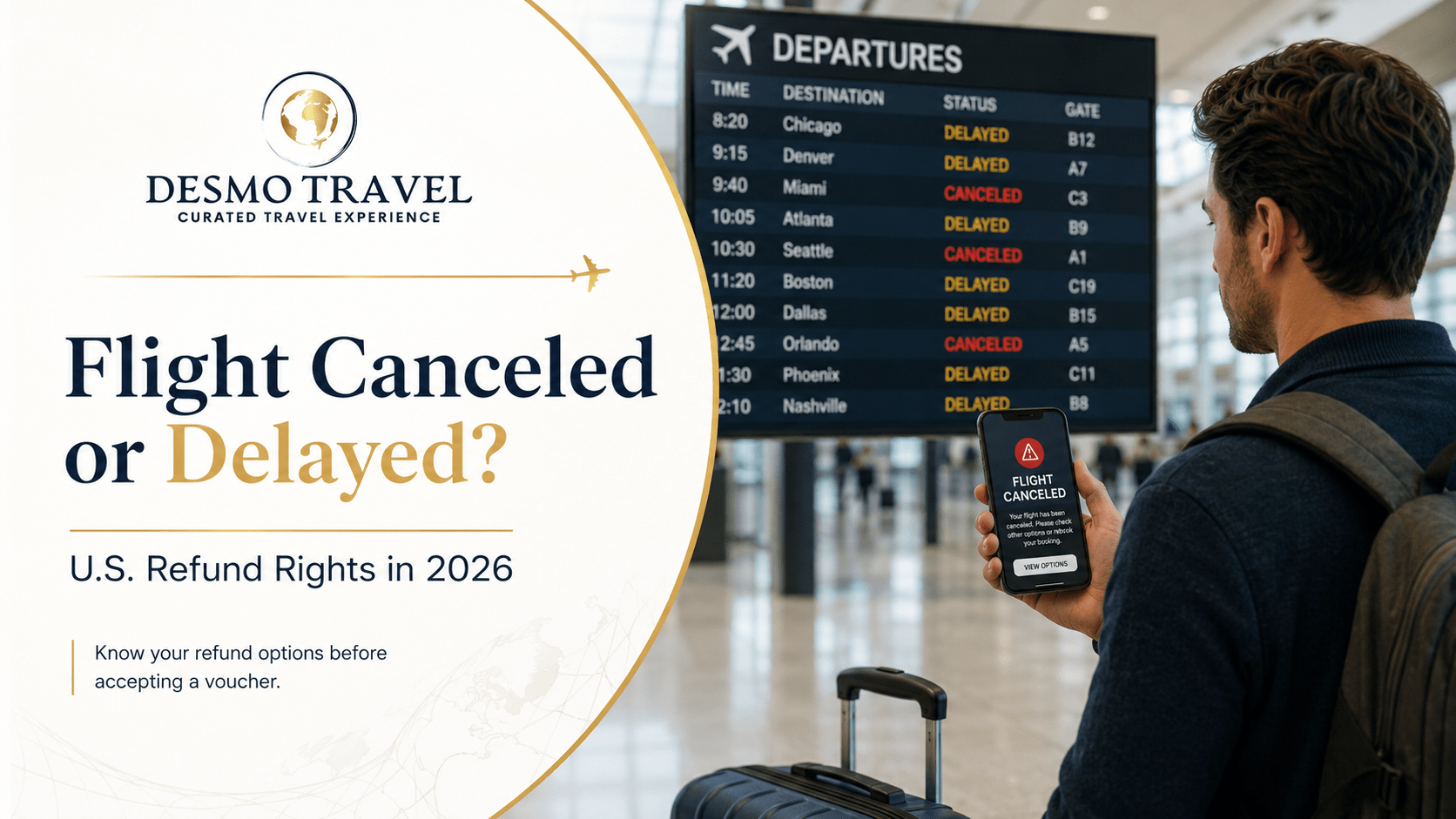
Flight Canceled or Significantly Delayed? U.S. Refund Rights in 2026
Last fact-checked: July 20, 2026
Direct answer: If an airline cancels or significantly changes a flight to, from, or within the United States, you can generally receive a prompt automatic refund when you decline rebooking, a voucher, or other compensation. Significant changes include qualifying time shifts, airport changes, extra connections, cabin downgrades, and certain accessibility-related changes.
Flight disruptions are stressful because the best choice depends on whether you still need to travel, how quickly you can be rebooked, and whether the airline caused the disruption. This guide separates federal refund rights from optional airline amenities so travelers can decide without giving up money they may be owed.
When does a canceled flight qualify for a refund?
Under U.S. Department of Transportation guidance, a passenger is entitled to a refund when an airline cancels a flight and the passenger chooses not to travel or accept the airline’s alternative. The reason for the cancellation does not remove the underlying refund right. The rule applies to flights to, from, or within the United States.
On July 8, 2026, DOT announced temporary enforcement discretion for certain renumbered flights through July 7, 2027. If a passenger is successfully rebooked under a new flight number and the trip operates without a significant change or delay, DOT may not enforce the cancellation-based refund requirement solely because the flight number changed. Other refund obligations remain in place. Check the latest DOT aviation consumer updates before relying on this narrow exception.
What counts as a significant flight change?
DOT defines several changes that may trigger a refund when you reject the changed itinerary. For most travelers, the easiest thresholds to remember are three hours for a domestic itinerary and six hours for an international itinerary.
| Change | Refund-triggering threshold or condition |
|---|---|
| Domestic departure or arrival | Three hours or more earlier or later |
| International departure or arrival | Six hours or more earlier or later |
| Airport | Different origin or destination airport |
| Connections | More connection points than the original itinerary |
| Cabin | Downgrade to a lower class of service |
| Accessibility | Certain airport or aircraft substitutions that remove needed accessibility features |
See the current DOT refund guidance for the complete definitions and examples.
How quickly should an automatic refund arrive?
When a refund is owed and the passenger does not accept the alternative itinerary, voucher, credit, or other compensation, DOT says the refund should generally return to the original form of payment within seven business days for credit-card purchases or 20 calendar days for other payment methods.
The refund should include the ticket price and fees for optional services that were not provided, such as baggage, seat selection, or Wi-Fi charges when the service becomes unavailable because of the disruption.
Should you accept rebooking, a voucher, or a refund?
| Option | Best when | Important trade-off |
|---|---|---|
| Rebooking | You still need to travel and the replacement works | Confirm airports, connections, cabin, and arrival time before accepting |
| Voucher or credit | You expect to use the same airline within the validity period | Check expiration, transferability, blackout dates, and fare differences |
| Refund | The replacement no longer works or you prefer another carrier | New fares may be higher by the time you rebook |
Do not accept a voucher automatically. Read its conditions first because accepting an alternative can affect whether an automatic cash refund is still due.
What airline assistance is separate from a refund?
Meals, hotel rooms, ground transportation, travel credits, miles, and rebooking on another carrier are not universal federal guarantees for every disruption. Airlines publish voluntary customer-service commitments for controllable cancellations and delays. The DOT Airline Customer Service Dashboard lets travelers compare those commitments by carrier.
Weather and air-traffic-control disruptions may qualify for a refund when the flight is canceled and you decline the alternative, but they do not necessarily require the airline to provide meals or a hotel. Travel insurance benefits also depend on the policy’s covered reasons, limits, and documentation rules. Review Desmo Travel’s travel insurance options before departure rather than after a disruption begins.
What should you do immediately after a cancellation or delay?
- Save the original itinerary, receipt, and confirmation number.
- Screenshot the cancellation or schedule-change notice and record the time.
- Check the airline app, service desk, phone line, and website at the same time.
- Compare the proposed itinerary with your original airports, times, connections, and cabin.
- Ask whether the disruption is controllable and which written commitments apply.
- Keep receipts for reasonable meals, lodging, and transportation.
- If you reject the alternative, state clearly that you want the refund returned to the original form of payment.
If your ticket was booked through a travel advisor or online travel agency, contact that seller first because the refund workflow can differ from a direct airline booking. Desmo clients can use the contact page or request a travel quote for help evaluating replacement options.
Expert note from Desmo Travel
Before accepting a replacement itinerary, compare the final arrival time, airport, number of connections, cabin, and baggage terms—not only the new departure time. A fast acceptance can make a poor replacement harder to unwind.
Reviewed by: Desmo Travel Airfare Desk. This article explains general U.S. passenger guidance and is not legal advice. Airline terms, government rules, and enforcement policies can change; verify the current DOT page and carrier policy for your trip.
Frequently asked questions
Do I get a refund if the airline cancels because of weather?
Generally, yes if the airline cancels the flight and you decline the replacement, voucher, or other compensation. Weather may affect whether meals, lodging, or additional compensation are offered, but it does not automatically eliminate the cancellation refund right.
Is a three-hour delay always refundable?
For a domestic itinerary, a departure three hours earlier or an arrival three hours later can meet DOT’s significant-change definition. International itineraries generally use a six-hour threshold. Other qualifying changes can trigger refund rights even without those time shifts.
Can an airline force me to take a voucher?
When a refund is legally owed, the airline should not substitute a voucher without your affirmative acceptance. Review any offer carefully and decline it if you prefer the eligible refund.
Does the 24-hour cancellation rule apply to travel-agent bookings?
DOT’s airline 24-hour reservation rule applies to qualifying tickets purchased directly from airlines at least seven days before departure. It does not require travel agents or online agencies to offer the same policy, although they may provide a similar option.
What if the airline does not provide the refund?
Contact the airline or ticket seller in writing, keep the confirmation and correspondence, and request the refund using the original form of payment. If the response is unsatisfactory, you can file an aviation consumer complaint with DOT.
Should I buy a new ticket before the refund arrives?
Only after comparing the airline’s replacement with current alternatives and considering the cash-flow impact. Last-minute fares can rise quickly, so confirm the refund eligibility and replacement cost before deciding.
Primary sources: U.S. Department of Transportation, Refunds; Airline Customer Service Dashboard; Aviation Consumer Protection: What’s New.
Disclaimer: This article is provided for general informational purposes only and does not constitute legal advice, a guarantee of refund eligibility, or a promise of compensation from an airline, travel agency, insurer, or government authority. Refund rights depend on the specific itinerary, ticket terms, payment method, nature of the disruption, passenger response, and current U.S. Department of Transportation rules and enforcement policies. Airline schedules, customer-service commitments, voucher terms, and government regulations may change without notice. Travelers should verify the latest requirements directly with the U.S. Department of Transportation, the operating airline, the ticket seller, and their travel insurance provider before making a decision. Desmo Travel is not responsible for airline cancellations, delays, schedule changes, refund-processing times, additional travel expenses, or decisions made based on this article.